
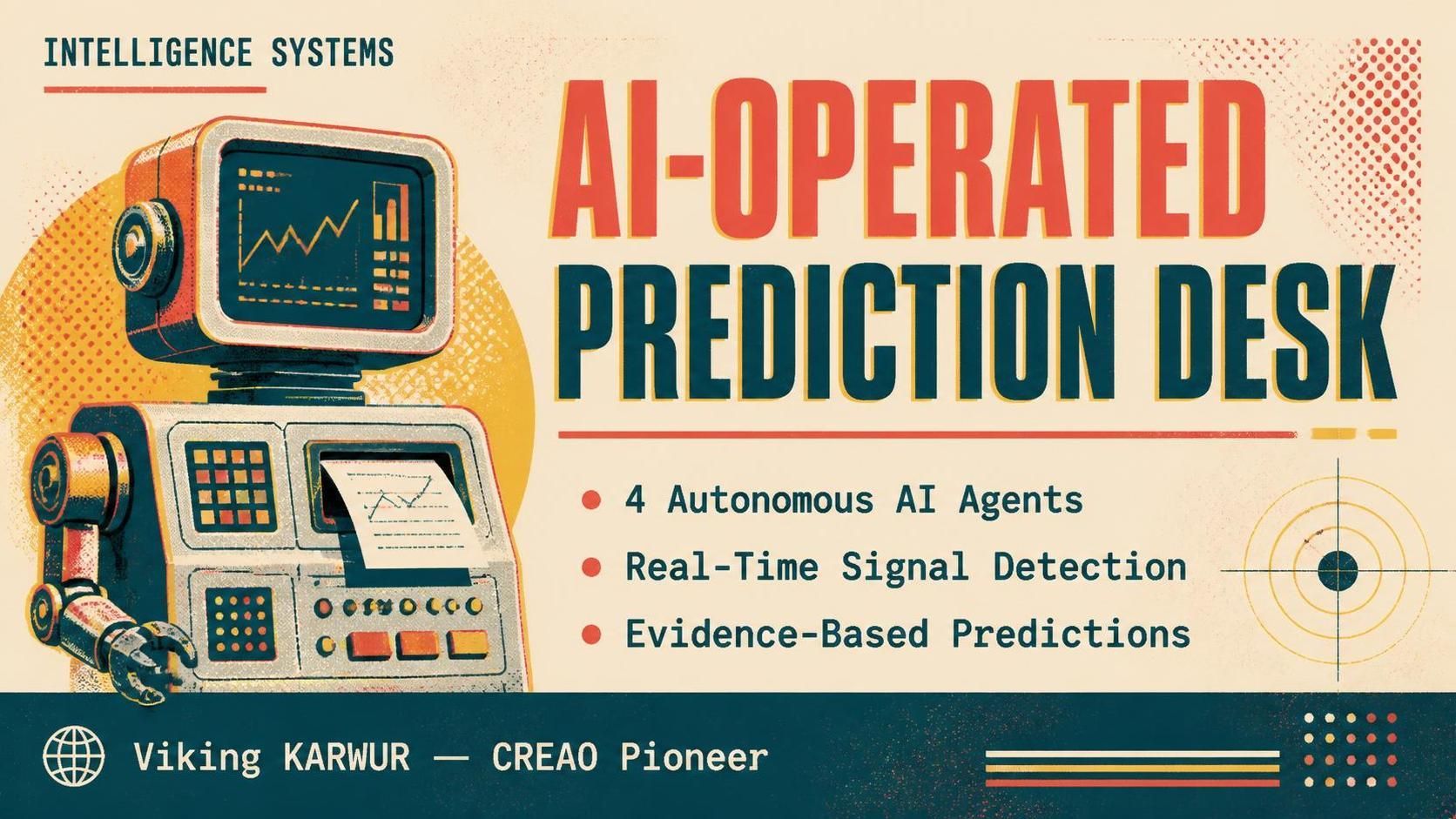
I used to spend hours reading industry reports, scanning news feeds, and manually piecing together signals to anticipate what might happen next in technology markets.
That process is now fully automated — and it runs 24/7 without me.
Welcome to the AI-Operated Prediction Desk.
🧠 Why We Need a New Kind of Intelligence System
The fundamental problem with human intelligence workflows isn’t intelligence — it’s speed and scale.
By the time an analyst reads the morning news, filters the noise, researches the context, and formulates a prediction, the market has already moved. Opportunities have been missed. Risks have gone undetected.
The world generates more signals per minute than any individual — or even a traditional team — can meaningfully process. AI doesn’t change that reality. But multi-agent AI systems do.
🔄 The 4-Agent Architecture That Changes Everything
The AI-Operated Prediction Desk isn’t a single AI tool. It’s an orchestrated pipeline of four specialized agents, each with a distinct role — and each feeding into the next.
Agent 1: News Monitoring Agent
The eyes and ears of the system. It continuously scans real-time sources — news feeds, research publications, social signals — looking for high-impact events in AI, technology, startups, and enterprise markets.
It doesn’t just find news. It filters for signal quality. Not everything that makes headlines matters. The monitoring agent has been trained to recognize the difference.
Agent 2: Research Agent
When the monitoring agent surfaces an event, the research agent goes deep. It builds a comprehensive intelligence brief: background context, historical precedents, expert commentary, supporting evidence, contradictory data, and community sentiment.
The key rule? No predictions at this stage. The research agent is pure analysis — evidence in, structured brief out.
Agent 3: Prediction Intelligence Agent
This is where the magic happens. Armed with the research brief, the prediction agent evaluates outcomes and assigns probability estimates. It compares its estimates against current market consensus to identify gaps — places where the market may be wrong.
Every output includes: Outcome → Market Probability → Agent Probability → Difference → Confidence Level. No vague speculation. Numbers only.
Agent 4: Reporting Agent
The final layer translates intelligence into executive action. Concise. Structured. Decision-ready. The reporting agent produces a daily briefing that includes: Executive Summary, New Opportunities, Markets Under Observation, Significant Changes, and Risk Watch.
500 words or fewer. Because if your intelligence briefing can’t be read in 2 minutes, it isn’t optimized for the people who matter most.
📊 What This Actually Produces
Every cycle of the AI-Operated Prediction Desk generates:
- ✅ Real-time event detection across AI, tech, and startup ecosystems
- ✅ Evidence-based research briefs with confidence scoring
- ✅ Probability estimates with market comparison deltas
- ✅ An executive intelligence report — ready for leadership decisions
And it does all of this continuously, at machine speed, with no cognitive fatigue.
🔮 The Bigger Picture: What Prediction Desks Mean for the Future
We are entering an era where the competitive advantage isn’t just having data — it’s having organized intelligence pipelines that convert data into foresight, faster than any human team can.
The organizations that win the next decade won’t be those with the most analysts. They’ll be the ones who’ve automated the workflow of intelligence itself.
This isn’t about replacing human judgment. It’s about amplifying it. When your AI desk surfaces a high-confidence signal about an emerging market shift, the human role becomes clearer: decide what to do with that signal, not how to find it.
💡 Key Takeaways
- Multi-agent pipelines beat single AI tools — specialization creates depth that generalist AI cannot match.
- Evidence > speculation — every layer of the prediction desk is grounded in structured data, not vibes.
- Speed is a strategic asset — the prediction desk operates 24/7 across every topic simultaneously.
- Confidence levels matter — not all signals are equal; a good system tells you how confident it is.
- Executive-ready output is non-negotiable — intelligence that can’t be acted on is useless.
🚀 What’s Next
I’m continuing to evolve this system — adding more data connectors, refining the prediction models, and exploring how the desk can serve as a foundation for real-time decision automation.
If you’re building something similar, or thinking about how AI agents can transform your intelligence workflows, I’d love to connect.
The future of competitive intelligence isn’t a bigger team — it’s a smarter system.
Built with CREAO | AI-Operated Prediction Desk | Viking KARWUR